
This morning, I sit on a rough bench under the cedar roof of a gazebo built on stilts over the edge of a small pond. Tied in a slip before me is a small wooden skiff, a bit over ten feet in length. It is made of cedar and oak with a stem of black locust. Its finish is paint, gray on the inside and dark green on the outside. There is no varnish. It is nearly as simple as a boat can be, yet it holds a promise of the pleasure of boating that will not be surpassed by any boat regardless of size or material. It will require little maintenance and when its life is over it will almost entirely decay to replenish the earth from which it was built.
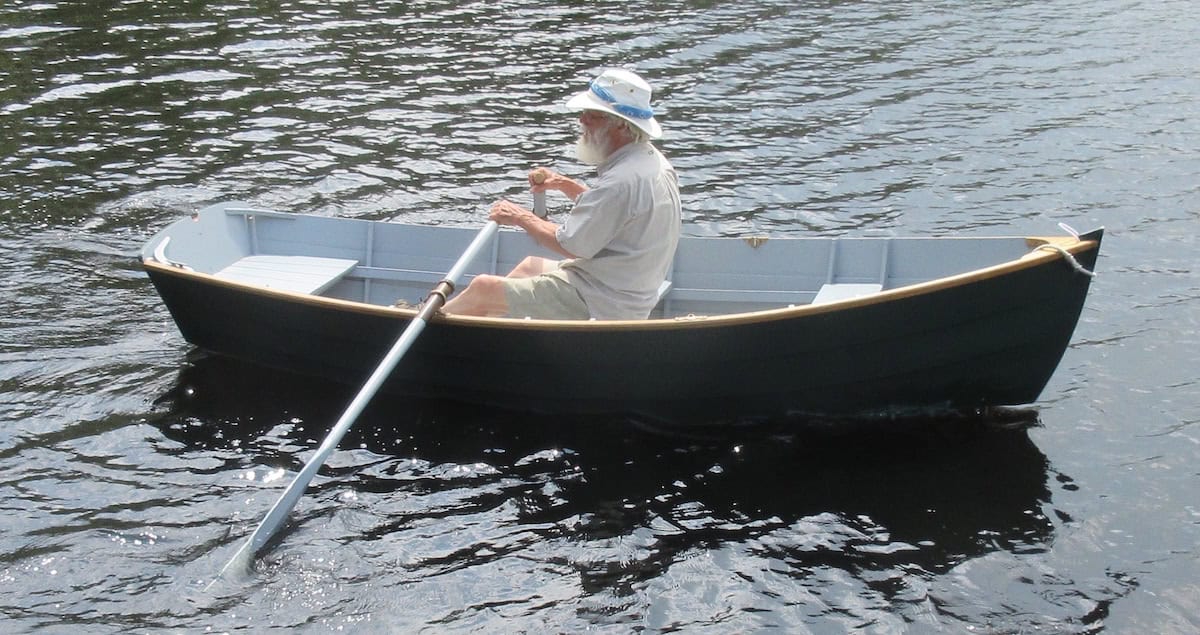
This little skiff was largely made with hand tools that form an intimate connection between the builder and the emerging boat. No matter where this craft is used or who is ultimately its owner, it has embodied within it, a portion of the builder’s life, an expression of his skills, and a kinship with builders of the past. It has a soul. We “own” things that we use and discard. We are“caretakers” of boats with a soul.

Robert Whitehouse says:
Harry,
We had a 10′ cross planked skiff with a temperamental outboard in East Boothbay. It had to be up out of the water and on its starboard side before it would start. But it would do it on the first pull.
We fished enough mackerel to cover the bottom sometimes. We caught pollock that my dad loved fried for breakfast. He would salt the mackerel into wooden kegs and bring them home to Virginia for a breakfast fry-ugh! We could smell them soaking in the kitchen overnight.
My Mom would give us a few dollars, and we would head over to a fish shack on the Little River for burgers and fries. It was a time when 12 year olds could just disappear for the day without any fuss or bother- as long as we were home in time to shower before dinner.
We had more fun with that boat, and to this day enjoys my best memories.
Rob Whitehouse
Brunswick
Robert Whitehouse says:
I forgot to mention. At the start of the season we would take it to the cove and tie it off in skinny water. It would sink of course. But three days later we would bail it out, and it would not leak for the rest of the season.
Keep things simple.
Geoffrey Adams says:
Can someone tell me if there are plans available for the skiff in the first picture with Harry in it? If so how can I obtain them? I think that it would surely fit with my desire for a good little skiff to be able to just row around the bay and bayous here in St. Andrews bay of the Florida panhandle. Thanks Harry for your insights into life and boating and building. I only wish that I could have found you earlier in my life to be inspired by. At 74 now, there may not be much time left to accomplish all that you inspire me to desire but I can do some anyway. Thanks again.
Robert Whitehouse says:
Geoffrey,
Well, draw a decent rocker to suit your eye. Set it up and build the sides however you would like. Lay in straight frames every foot or so. Use your eye. Cross plank it in 4/4 really tight. Use dry boards on the bottom. Don’t bother with caulking. Add a single rowing station and some hardware. A few seats.
Drop it in the water and let it tighten up. It will probably sink at first.
Have fun!
Rob
Simon Paroz says:
Hi Harry,
love your work mate,
thanks for sharing.
scott garven says:
Hi Harry, Would you be able to tell me what would be the best, easiest to build, small sailing dinghy that you would suggest to a wooden boat club in Australia. I would really appreciate your opinion.
Harry Bryan says:
Scott,
I can’t tell you what the best dinghy is but it will be hard to beat Joel White’s Nutshell prams or his Shellback dinghy.
scott garven says:
Thankyou Harry for your reply and your amazing contribution to boating
Dave Dickmeyer says:
Some eye opening statistics for sure. My boat is a glued lapstrake sailing/rowing dinghy of my own design. Yes, I used epoxy, but most of it is plywood or mahogany so someday most of it will return to Mother. That is unless it ends up in a museum somewhere, which could prolong that process. I can only hope! 😆 Thanks Harry for the great article.
William Aaronson says:
I too am a lover of wooden boats for all the reasons noted by Mr. Bryan. I also love the sound of a wooden boat prying her way through the water, the reassuring, solid, hulk of a sound produced by a wooden boat underway. It is music to my ears.
William Newman says:
What a legend and clear thinker.Harry should be president!
Eric Simes says:
Harry is correct as always. I have built over a dozen boats in my 80 odd years, all of wood. I have also owned aluminium commuter boats, which were uncomfortable in a chop and a pleasure to get out of. As for timber boat maintenance, like all things, if you take care, there is no problem. One of my boats, a Gartside “Jessie”, I sailed every summer for 13 years without ever touching up the varnished hull or interior. It was washed, dried and put under cover to keep the UV rays away. As Harry says its all part of the pleasure of wooden boat custodianship.
Sam Benson says:
Oh to have a mentor like Harry! I admire pretty wooden boats immensely, but always in the back of my mind I’m glad that I don’t have to foot the maintenance bill. I dont have the tools, space or skills to take care of one properly. I own fiberglass boats because I have very little time to enjoy them, and with an occasional coat of paint I’m on the water. My largest boat is 19 feet, 20 years old, and solid as a rock. It gets me offshore to fish and to races to watch my kids sail. I’m a member of OCH because I love beautiful boats, and those are almost always made of wood, but without a mentor to learn the skills from and the time to practice them I am left to get joy from plastic boats. Harry, I admire your ethos, and in fact it was one of your posts that led me to join OCH years ago. As many say, you are an inspiration. I’m trying to keep up!
walter page says:
Life is all about priorities . Anyone can learn to care for a beautiful or ugly wooden vessel. You don’t need a mentor when you have a library and YouTube….Just do it, take the time what ever it is and feel good about it. Everyone only gets so many Springs in their lifetime…spend it caring for something beautiful!
Philip Myer says:
Thank you Harry, wise words- Philip, from Tasmania.
Van Beck says:
Thank you. This piece makes way too much sense.
William Mittendorf says:
All boats require maintenance. If you neglect an hour of cosmetic maintenance on a wooden boat, you may be made to pay with a cascade of repair hours soon after. The same can be true for metal boats. To keep a fiberglass boat in Bristol condition is close to as labor intensive as is a wooden boat. The difference is that fiberglass cosmetics, if neglected, can be brought back quite easily, and the danger of structural decay is much less than wood. Composite structures are their own complicated story, as are cold moulded wooden boats. Are fiberglass and metal boats as pleasant to use and to be on as are wooden boats? Sometimes, but generally not.
Ted Walsh says:
Wonderful post Harry. I wish more boaters understood the message you so clearly spell out. Next year will be our twenty-sixth season with our wooden Friendship sloop. We still do all the maintenance ourselves. She is more precious to us because we have invested so much of ourselves in her. The fact that we have saved a lot of money in the process is more of a wonderful byproduct than and end goal.
Love your writing!
Glenn Holland says:
AMEM Harry. Just this week, I have been passing time with my 92 year old mother, remembering the CC kit boat (all wood) the family built when I was about 5 years old. I’m 75 now and those memories are some of the best…her’s and mine.
Paul Follansbee says:
Harry’s observation that “many kinds of of work can be enjoyable” is something that owning a wooden boat has taught me, and that awareness has grown to apply to all kinds of daily tasks that I used to dread. It helps me to truly appreciate what I have, rather than ruminate mindlessly on what I don’t.
Richard Roach says:
You got it Harry.
Peter Strock says:
Interesting: For 50+ years i was a cruising chum of Mait Edey, one of the builders of the Stonehorse, of which he owned a wooden version. He introduced me to L. Francis Herreshoff and others and when he went “over the bar” he was sailing a modified Swampscott dory. The success of people like Gannon and Benjamin and others devoted to wooden boats and the persistence of this web site speak to the value of experiences that allow us connect with the world around us. Yes, i own a glass H-12 1/2, but like the Stonehorse I am reminded every time about the genius and beauty of her conception.
take a young person sailing with you and teach them the arts of the sailor. Give them a membership at OCH.
Remember the axiom: Give a man a fish, and you feed him for a day. Teach a man to fish, and you feed him for a lifetime.”
John Wujack says:
I was fortunate to meet Mait Edey during the launch of my first built boat, an Egret Sharpie in Key Largo many years ago. He said two things that have stuck with me decades later. First, she was on her waterline and second after I said that I was happy that was done with, he said “You’re not done, the job description has just changed.” 40 years on I sail one of Edey & Duff’s Stone Horses ion my home waters in Poulsbo, WA.
Eric Phinney says:
Well said and understood. Just two days ago I ordered plans for the Catspaw dinghy. Can you advise where in New Brunswick I will be able to find the cedar for planking. I did a number of planks on a catspaw when I was at Wooden Boat School and was very pleased with the stock they maintained for getting planks out from.
Harry Bryan says:
Eric,
I have almost always cut my own cedar and so am a poor source of information on where to find local mills.
I typed “sawmills sawing cedar in New Brunswick” and “sawmills sawing cedar in Maine” into my computer and found several sources that seemed well worth contacting.
James Reinhard says:
Fiberglass boats are hardly maintenance free
Alan Kane says:
Simple pleasures, and going small should become a trend. I always liked the saying” a boats use is inversely proportional to it’s size”. Having the smallest vessel to do the job would be best, not the biggest you can afford. Having the time, or taking the time, and going with wood is even better. Harry’s approach brings a lot more contentment, and is good advice.
Bradford Christo says:
Harry’s last sentence encapsulates very good reasons for why I purchased and restored a wooden sailboat, and eventually built a dinghy. There is an underlying gestalt to stewarding a wooden boat. You only come to fully understand this when you have done so. Thanks for this important perspective.
Don Tuski says:
I could not agree more. I have an old wood sailboat that I simply love to work on and then sail. Wood is one of the rarest materials in the universe and thus should be preserved and cherished.
Great post, Harry.
Don
Donald Fraser says:
Thanks, Harry,
The numbers you quote are astounding! My question is: how do you get the message to the masses?
I have built a number of wooden boats. In my area they seem to be difficult to market because of the perceived shortcomings of wood vs. fibreglass. Almost every inquiry I’ve had about boats I’ve built seems to elicit the question: Is there any fibreglass used in construction? I reply “No”. The interested party appears to lose interest immediately. I go on to preach the merits of wood, nevertheless!
Your comment on disposing of a f/g boat compared to shopping bags may open some eyes……I intend to use that comparison when touting the benefits of wooden boat construction!
Thanks again for a very poignant article.
Scott Langille says:
Harry, you, your lifestyle and your writings are an inspiration. Thank you for sharing this one!
Curt Varner says:
Very well said. I would offer the observation that before ordering a new fiberglass boat, folks should seriously consider saving/restoring one of the many old fiberglass boats that otherwise will soon find their way to a landfill. We have a 1972 Stone Horse 23 (fiberglass hull with wooden mast and spars). Would I be happier if she was wood? I think so. But I love her anyway and with care she should outlast me by a long shot.
With respect to boat building, I started out with stitch and glue and then moved on to glued lapstrake to reduce the amount of epoxy used in the building process. Even so, I find myself pulling on the disposable gloves and donning my respirator to mix up batches of epoxy and filler or sand epoxy finished pieces. No more epoxy boats for me, I have ordered a set of plans for Joel White’s Catspaw Dinghy and will try my ungloved hand at traditional boat building.
Alfred Buxton says:
There is another factor to wooden boats that Harry doesn’t mention. Sitting in and sailing, or rowing, or motoring in a wooden boat has a totally different feel than a f-glass boat, especially one made of real wood. It’s. Even better if you have built it yourself, but even if you haven’t built it, there is a real difference. Maybe it’s just going back to my youth, but real wood is good!
Dave Nutter says:
With the good fortune to be a neighbour, Harry never ceases to inspire our community.
Christopher Bolton says:
There’s a theme running through my life at the moment that I can’t quite put a name to. But you seem to inform it so I know where to look for clues. This article speaks to it for sure. So does our current build, with friend KT, of your Ladybug Pram. So, thanks Harry.
Steve Stone says:
Thanks for this note, Christopher. Curious — if you can’t quite put a name to the theme running through your life at the moment, can you describe it?
Luc Milam says:
All wood, all good!
edgar gatewood says:
All well said.